Now that all of our K-4 students are together in one school, I thought it would be fun for the 'big kids' (4th graders) to make Christmas and Channukah cards for our Kindergartners. It is a fun way for students to use the language for a real purpose and builds community between grade levels, fostering the notion that Spanish can be used to communicate with others. We are keeping the messages very simple, so that the Kinders can understand them, with a related illustration on front. The added bonus is that students reinforce letter-writing vocabulary, such as 'Dear...' and 'Besos y abrazos' or 'Saludos' or 'Adiós'.
Too cute!
Thursday, December 10, 2009

Tuesday, November 10, 2009
Word Banks
Word banks are a great way to organize vocabulary for students, collecting the necessary words and phrases around a particular theme or activity. Sometimes a word bank consists of vocabulary around a cultural theme, such as this one for a unit my first graders are doing on Venezuela.
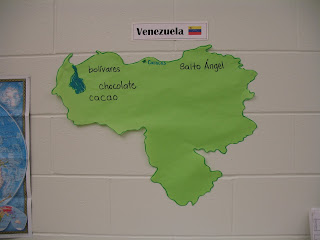
We have just begun this one, adding important cultural info to a large map of Venezuela on the wall in my classroom- Salto Ángel, bolívares, chocolate, cacao....more to follow. For the little ones, this is a great visual as well as an organizer and reinforcer of what they are learning.

We have just begun this one, adding important cultural info to a large map of Venezuela on the wall in my classroom- Salto Ángel, bolívares, chocolate, cacao....more to follow. For the little ones, this is a great visual as well as an organizer and reinforcer of what they are learning.
Thursday, November 5, 2009
Great video!
This is short but terrific! An aerial view of Salto del Ángel in Venezuela.
http://www.youtube.com/watch?v=yEztVvy3G_4
http://www.youtube.com/watch?v=yEztVvy3G_4
Wednesday, October 21, 2009
Friday, October 16, 2009
List Poems

List poems are a great way to allow students to create a finished piece that has intrinsic value all on it's own and at the same time reinforces vocabulary and structure. This list poem about a butterfly egg was done by a second grader- she chose a picture to write about, made a list of vocabulary which described the picture, and illustrated the poem. The nice thing about list poems is that there is no need for rhyme or meter, making them accessible to lower level students. Even students with a small core of vocabulary and little knowledge of grammar can create one- at it's very simplest it can be merely a list of adjectives or verbs centered around a theme, such as an object, a picture, an idea, etc.
Saturday, October 3, 2009
¡Torta!
I devised this card game, modeled after 'Torta' (a game from Spain) and Slapjack. My fourth graders are working on the constructions 'me gusta', 'me gusta mucho', 'no me gusta' and 'me encanta' with various activities such as skiing, playing basketball, reading, etc- 12 total. I found a bunch of picture depictions for each activity and made enough copies to make about 84 cards (thereby each activity is represented several times).
To play I divided the class into two teams and split the deck in half. (I prearranged the cards so there would be lots of matches). A member from each team comes up and they both turn over a card at the same time, like in Slapjack. If the cards are the same, the first kid to slap the cards and call out 'Torta' is the winner, but not until he or she has made a sentence with the activity and one of the constructions (like 'Me gusta patinar'). That team then gets all the cards that have been turned over. If the cards are not the same, the next two players come up to turn a card, and so on. At the end of class, I tally how many cards each team has and a point goes to the team with the most cards. I keep a running scoreboard so we can track over time how the teams are doing.
To play I divided the class into two teams and split the deck in half. (I prearranged the cards so there would be lots of matches). A member from each team comes up and they both turn over a card at the same time, like in Slapjack. If the cards are the same, the first kid to slap the cards and call out 'Torta' is the winner, but not until he or she has made a sentence with the activity and one of the constructions (like 'Me gusta patinar'). That team then gets all the cards that have been turned over. If the cards are not the same, the next two players come up to turn a card, and so on. At the end of class, I tally how many cards each team has and a point goes to the team with the most cards. I keep a running scoreboard so we can track over time how the teams are doing.
Wednesday, August 19, 2009
Practicing Names
A cute traditional rhyme for practicing "Me llamo ____" :
A E I O U
Arbolito de Perú
Yo me llamo _____;
¿cómo te llamas tú?
I like to play a game with this rhyme once the students have learned it. The students sit in a circle. The students recite the first two lines, I say the third and fourth, rolling a ball to a student who then answers the question. We then start again, the student now saying the third and fourth lines and rolling the ball to another student. The game continues until everyone has had a turn. For a silly twist, you can write out the students' names on cards, shuffle them and pass them out, making sure students get a name other than their own. Or you can write names of famous people or cartoon characters. Finding ways to practice the construction 'My name is ___' and 'What's your name?' in an interesting manner can be difficult, but this game works well, is fun, and of course, the rhyme is authentic so a cultural element is tapped as well.
A E I O U
Arbolito de Perú
Yo me llamo _____;
¿cómo te llamas tú?
I like to play a game with this rhyme once the students have learned it. The students sit in a circle. The students recite the first two lines, I say the third and fourth, rolling a ball to a student who then answers the question. We then start again, the student now saying the third and fourth lines and rolling the ball to another student. The game continues until everyone has had a turn. For a silly twist, you can write out the students' names on cards, shuffle them and pass them out, making sure students get a name other than their own. Or you can write names of famous people or cartoon characters. Finding ways to practice the construction 'My name is ___' and 'What's your name?' in an interesting manner can be difficult, but this game works well, is fun, and of course, the rhyme is authentic so a cultural element is tapped as well.
Subscribe to:
Posts (Atom)